Monday, August 27, 2012

Music Experimentation

I was having quite a bit of fun last night with something new I discovered I could do with my keyboard (Roland Fantom X8).  There is a microphone input that can then be piped through the effects!  This microphone input can be from an actual vocal microphone, but it can also be from an MP3 player or whatever else.

What seemed most interesting was putting this input sound through a combination of a delay and a phaser -- both of which I can modify on-the-fly.

I discovered that just tapping the input lead created a very interesting effect.  So I recorded a little bit of this while playing with all the dials on the phaser while keeping the delay constant at 174 milliseconds.  I then mixed in with this a fairly random "melody" on top of this tapping sound, and came up with this:


I call this song 'Finger On Wire' because that's literally what I was doing -- just putting my finger randomly on the end of this input wire.

I know, I know -- it isn't really all that interesting and really it's more like annoying noise.  I'm just experimenting so gimme a break.  At some point down the road I'm sure I'll find a need for this kind of effect and now I'll know how to do it.

Tuesday, July 24, 2012

Feel The Noise

The title of this entry has many meanings.

I haven't made any updates to this blog in over a month.  This isn't because my work in Astronomy & Music hasn't been moving forward, it's just that up until now there hasn't been enough to report on.  But now I have a few stories to tell.

My astronomical research has been going a bit slow.  I'm allowing this to be an organic process so sometimes there will be temporal gaps in the work I'm doing.  This is sort of what's happening at the moment.  But I'm still thinking about some things and doing a little work.  The Zero Zero project is currently on hold, but is still in my thoughts.  A new project has surfaced which I will now explain.

Astronomical Music

About a month ago, I came up with an idea that I could "play" astronomical data, and any kind of data for that matter.  I'm still not exactly sure how this is going to work out, but let me try to explain.  The first thing I'm going to do is create a single-note song that varies in amplitude.  The amplitude information will be produced by taking an image of a spiral galaxy and measuring the brightness of each pixel along a particular row.  I will convert this brightness value into an amplitude value for the single notes I'll be playing.  Once this is done, I'll give it a listen and see how it sounds.  I'll also probably run through other rows and columns, and maybe even some diagonals.

Depending on how this initial peek at playing astronomical data, things could go in a couple directions.  First, of course, is nowhere.  If I take a good hard look at the sound that is being produced and I can't see any value in it, then this project is finished.  On the other hand, if I even have a HINT of something interesting, I'll continue to pursue this project by encoding different information into the MIDI file that will represent different aspects of the astronomical data.  For instance, each row or column in an image could represent a note on the keyboard, with the brightness of the pixel representing the amplitude of the note.  Anyhow, the sky is really the limit (I hope) in terms of this work and I'm as excited as I can be about it.

What this all hinges on right now is writing some software to create MIDI files.  The MIDI file will then be read/played by my synthesizer to produce the desired sound.  Anyhow, this is where I'm "stuck" at the moment.  Not because I'm not able to write the software (I was a fairly good programmer once), but because the motivation to write the software hasn't been there.  I've been more focused on my musical development.  In any case, I'll keep you posted on this new and very interesting project.  When I have some sound to share, rest assured that I'll make it available for everyone.

Music

My musical development continues.  The band I'm in has been on a short break because one of our members had to do some traveling.  But now he's almost home and we'll be getting back to rehearsals this coming Wednesday (7/25/12).  At the same time that we took our little break, one of the buttons on my keyboard failed.  It is probably the most important button on this board and therefore the most used and therefore the one most likely to wear out.  When I got my Roland Fantom X8 over a year ago, this button was already flakey, so I knew it was just a matter of time.  Well, that time came a couple of weeks ago -- pushing the button did NOTHING.

So I wrung my hands for a few days as I seem to do.  I got ahold of the service manual and learned how to properly take the device apart in order to get into it.  With the exploded views of the interior, I found exactly the button (and it's technically a switch) that had failed on me.  It's located on a circuit board with nine other buttons/switches.  It connects to the rest of the device via a small ribbon cable.
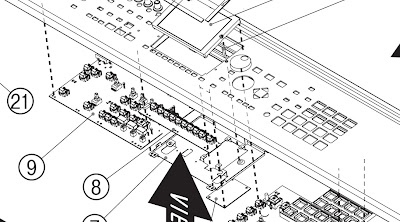
Circuit Board '8' is the one that was replaced -- the one in the center with those ten buttons

[Just as an aside, it really met one of my primal urges to finally tear into this synthesizer.  I've been wanting to ever since I got it, but have been resisting the urge until "absolutely necessary".]

So by last Monday (7/16/12), I knew exactly what I needed and I had a couple of crude contingency plans if the primary plan didn't work out.  The primary plan was to call Roland and see if I could order the circuit board from them or a supplier.  I was nervous and excited at the same time.  I'd created several amazing horror stories in my imagination about this whole thing and in hindsight they were pretty funny.  Anyhow, I get on the phone with Roland and I describe the situation.  He asks me for a part number and I gave it to him (it's part .  Then he says something like, "Ok, the part is in stock and will be shipped to you today.  That'll be $18.49 plus $6 shipping for a total of $24.49.  Would there be anything else, sir?"

So that was that!  Three days later (this past thursday -- 7/19/12) the circuit board arrived and in about 5 minutes I had it installed.  Now the moment of truth.  Will the button work?  Did I screw up something else?  Did I zap one of the circuit boards with static?  Will the board even turn on?

The end of the story is that everything is working great now and I've been reinvigorated (as if I needed to be, ha!).  So much so that I've started up with a real "bang" and learned two very cool songs in a matter of hours.  One is 'Jackie Blue' by The Ozark Mountain Daredevils, and the other is 'Red Sector A' by Rush.  I'm in the process of making a decent recording of these and will post them to Soundcloud when I get them done.  Both of these songs are VERY infectious and I can't seem to get enough of playing them.

I feel as though I've graduated to a new level after learning 'Red Sector A'.  Of course I knew of Rush, but I was never a big fan until only a few months ago when I saw an incredible biography of them on TV.  That show convinced me that I really needed to take a good look at these guys and what I found was amazing!  The music is incredible and so are Getty, Alex, and Neil as people.  This is actually one of the first bands in which I know the names of the band members.  Their names just stuck in my head!  Anyhow, it took me a couple of hours to get the song down, and now I continue to work on getting the "right sound".  I'll be doing the vocals on this song, and I found the original key (the first note played is a 'D') to not be in my range.  So I transposed it up to 'G' and this works really well for my vocal range.  What a totally awesome song.  As I said, I really do feel as though I've graduated with this song and if I can do this song then there really isn't much I'm not capable of.  Hmmmm, is there a hint of pride in that last sentence?????

Tonight is a weekly Jam session (with another group of amazing musicians, exploring the outer reaches of the musical chaos) and then tomorrow is our bi-weekly rehearsal with the band.  We're going to be changing the format of the rehearsal in that instead of randomly going through the songs in a "what do you want to do next?" way, we're going to start playing the songs in the order we'll be performing them.  I'm excited about making this step because that puts us that much closer to starting live performances.

I'll make a better effort to post blog entries much more often.  I know that my supporters (present and future) appreciate seeing the progress (or lack thereof).

Peace to All

Thursday, May 31, 2012

Crowd Funding Is So Groovy

As I detailed in my introduction, I'm doing crowd funding but with a little twist in that I'm looking for regular, monthly supporters and I'm putting a cap on that support at $2500, or 500 supporters, a month.  Below is part of an interview with a musician that just received 22,000 donations totaling over 1 million dollars.  I have no interest in having that huge level of support, but the idea is the same regardless of dollar amount.
It is a huge feat to convince people you're doing something worthy of that much money.
The way I look at it is this isn’t really so much about me anymore. I’m the one doing it and I’m glad I’m the one doing it. I’m glad I’m not putting this album out on a fucking label, but I’m hoping that I’m just one of many. Hopefully I’m just the first big successful one. The minute someone bigger than me comes along to do this I won’t be jealous, I’ll be ecstatic because I really believe in the philosophy of crowd funding and the philosophy of being directly connected to your fans, business-wise, and being in charge of your own creative destiny instead of letting other people do it. What this is showing people is that the system works. Anybody can do it. I get a lot of criticism for saying that because there are a lot of people saying, "Of course you can do it. You’re Amanda Palmer. You’re famous. You were on a major label." But actually anyone can do it on any level. You just have to apply the rules differently depending where you’re at.
This is taken from a larger article that you can read here.

My Supporters

Here is where I'll keep a list of all my active (black font) and non-active (purple font) supporters:

Mark M
Karla C

Tuesday, May 29, 2012

Zero Zero Project Update

The goal for yesterday was to, in some way, create a semi-automated method to grab images of individual stars from the SDSS3 survey.  What I came up with is a program that creates an IRAF script that goes out onto the web, grabs a specified full-frame image, and then extracts a small portion (128 pixels by 128 pixels) centered on the object I'm interested in.

IRAF stands for 'Image Reduction and Analysis Facility' and pretty much any astronomer at least knows of IRAF if not relies on it heavily for all kinds of astronomical data reduction and analysis.  I worked in the IRAF programming group for a couple years back in 1998, so I'm still fairly familiar with how it works although it's clear that lots of things are pretty rusty and full of cobwebs.

It looks like from the structure of the SDSS3 that pretty much everything is keyed off of the Object ID number, or 'objId' for short.  The number that is associated with objId is encoded such that it contains information on which image taken with SDSS has the object I'm interested in.  So just from the objId, I could find the original image that a particular object is on.  This information is also contained in the SDSS3 database, so if need be, I can get the info I need from that.

The other thing I did yesterday was to start creating my own local database to store some of the more useful (to me) info that I'll need to complete this project.  For starters, I created a database table that contains the objId, object position in the sky (Right Ascension and Declination), magnitude (for all five filters), and position of the object within a given SDSS3 image.  This will allow my program to access the data it needs easily and quickly.  There's a good chance that sometime soon I'll access the SDSS3 database directly from one of my own programs, but for now this is great.  For the small amount of data I'm working with (9000+ objects isn't all that much considering computer disk capacities these days) it wouldn't matter if I kept all this information in a simple text file rather than a database, but working with databases is very easy and it gives me a lot of flexibility.

So as I said, what this program does is create a 'script' that can then be run in the IRAF environment to extract the images I request.  For those of you who may not know, a 'script' is a list of commands that are executed by the computer sequentially.  So in my case, the script grabs the full-frame image from the SDSS3 and then extracts a small 128x128 pixel "postage stamp" image from that.  I do this for all five wavelengths.  In the end, I have five 128x128 pixel images.  Here they are labeled with their respective color filter designations:

ObjID 127660236032507958, r magnitude 18.53, R SNR 55.27
These are five images of the same object (I just picked a random one) on the same brightness scale.  The signal-to-noise ratio (or SNR) for the 'R' image is about 55, which is more than adequate.  Any SNR above about 10 is acceptable.  The 'Z' image (lower right) is the faintest of them all showing quite a bit of noise.  Yes, the SNR of the 'Z' image is 9.5, which as you can see from the image is still ok (I can still see the star although there's a lot of noise) but is getting questionable.  The measurement errors, for example, will be greater in this image than the other images.

I do what I call a "simple SNR computation" by looking at how much the noise is varying compared to the brightness of the star.  So to use the jargon, I compute the ratio between the maximum value in the image (which will be the brightest pixel in the star) and the 1 sigma standard deviation of the image.  When I divide the two (max value divided by the standard deviation), I get a "good enough" estimate of the SNR.

So now I have a basic tool to extract images from the SDSS3.  Yehaw!  What exactly am I going to do with those images?  Not sure yet, but having the capability at hand will definitely come in handy -- if for no other reason just to take a look and see what I've got!  They say a picture is worth a thousand words and in astronomy that is VERY true.

Friday, May 25, 2012

Eee To Bee Music Project

Here's today's musical exploration.  I've had this sequence in my head for a few days now and I finally got to recording it.  Sorry for the noise -- I'm still learning how to properly record.

I call the song 'Eee To Bee' because that's exactly what the left hand is doing the entire song: E, D, C, B over and over and over and over.  Very cool sound, IMO.


Enjoy and I'd love feedback on this continuing project.

Thursday, May 24, 2012

A Lesson On Astronomical Magnitudes & Colors

In working through my first astronomy entry, I realized that I needed to remember how astronomical magnitudes work and how to interpret plots like the ones I made.

In astronomy, the brighter the object, the smaller the magnitude value.  So, for example, a star at magnitude 1.0 is brighter than a star at magnitude 2.0.

This also goes for looking at the same star with various color filters.  Mainly because of temperature, stars will appear to be different brightnesses depending on which color filter is being used.

To take a fairly extreme example, White Dwarf Stars are very hot and are therefore brighter at the blue/violet end of the spectrum as compared to the red end of the spectrum.  Say that I measure the magnitude of a White Dwarf star using a blue color filter and got a value of 13.6 -- call this value 'U'.  Then I measure the magnitude of the same star using a red filter and got a value of 14.3 -- call this value 'R'.  The difference in the magnitude --- U minus R --- is -0.7.  This means that that value of R is greater than the value of U -- duh!  But because you have to sort of "think backwards",  the star appears brighter (a smaller magnitude value) in U than is does in R.  This tells me that the star has a pretty high temperature, which is exactly what would be expected from a White Dwarf (surface temps are usually around 30,000 degrees Kelvin).

So in this example from my previous entry:
The more positive the U-R values are, the fainter the stars are using the U color filter (which corresponds to blue/violet).  So in the plot above, you can see that there are actually only a handful of stars that are brighter in the blue than they are in the red (the 'R' filter).

Also, looking at the y-axis, most of the stars have a positive U-R value, which means that they're they're brighter using the very red R filter than they are using the no-so-red U filter.

But as you can see from the plot, there are still quite a few stars that have negative color values.  Some or most of these will likely end up being White Dwarf stars.

So you can see what I'm able to do just by looking at this plot: I can get a general feeling for what kinds of stars I'm dealing with in the small field of view.  There are mostly red or yellow stars and a few blue or white stars.  More details on this to come in the next few days.