Thursday, December 16, 2021

b Per Obs Campaign Begins

From now until 30 December, I'll be measuring the brightness of b Per.  This system is expected to go into eclipse sometime around 22 December, but no one knows for sure.  It's a complex system.

Here's the alert from AAVSO.

I'm looking at the images from last night (16 December 2021 UTC) and yes indeed I'm seeing it just fine.  I'll be able to grab this data no problem.  Whether the data is useful?  Time will tell.

Here's one image from about 04:00 UTC (target b Per indicated with an arrow):


... and one from 05:00 UTC:


.. and at 06:00 UTC:


I'll start grabbing all this data pretty soon...  I should have this on multiple cameras.  I'll grab all the vids and see what's what....

Those nearby stars are only a couple degrees away so I'll be able to pretty confidently do differential photometry and cheat a lot of the calibration problems associated with absolute photometry.

BTW -- here's the full image to show what I'm dealing with:


Very beautiful, but what a mess!!!!

In any case -- full steam ahead

Wednesday, December 15, 2021

Looks Legit!

I've been looking at the possibility of doing photometric measurements of stars and other targets in these all-sky camera images.  Since magnitudes are being computed for the meteors and the stars detected in each FOV, I can only assume that I can get pretty nice calibrated photometry.

I was all ready to start diving into the RMS code to find the info I need to do the translations between pixel values and magnitudes, when it dawned on me that if I did differential photometry, I wouldn't have to worry about any of the problems associated with trying to get an actual magnitude.  I'm fine with magnitude differences.

As a reminder, the difference in astronomical magnitude is defined as:

M2 - M1 = -2.5 log10 (I2 / I1)

I can measure I1 and I2, which are the sky subtracted sum of pixel values centered on the reference or target.

Here's the I1 and I2 values as a function of time for the reference (rho Per, red dots) and target (Algol, beta Per, black dots):


... and when I compute the differences in magnitude, I get this:


What this is telling me is that over this time period (which as you can see lasted from about the beginning of the eclipse to just barely past the mid-point), the difference in magnitude goes from about 0.25 to 1.3 (+/- 0.1).

The actual difference at mid-eclipse IS 1.3 magnitudes!!!! (https://en.wikipedia.org/wiki/Algol).

I also measured the precision of the reference star.  There were 1200 total data points.  Of those, a few were obvious problems.  In the end, I used 1163 data points (96.9% of the data), and got a precision of about 10%.  I can tighten up on the data points selection a little but (eliminating outliers), and actually get down to about a 6% spread.  That's acceptable for the data I have!

This is all very encouraging.  I'd like to get a full eclipse.  The next one that'll be visible from my side of the planet is on 21/22 December (UTC):

start: 22 Dec 2021 07:52 (00:52)   mid: 22 Dec 2021 12:41 (05:41) end: 22 Dec 2021 17:30 (10:30)

and then a better one on 27/28 December (UTC) that'll be going on all night:

start: 28 Dec 2021 01:30 (18:30)    mid: 28 Dec 2021 06:19 (23:19)    end: 28 Dec 2021 11:08 (04:08)

Good times!

More Geminids 2021


and this is it for now... 742 detected meteors in this image:

I've also been playing around a little with putting some false-color on these to see how they look.  Here's some examples:


Monday, December 13, 2021

Geminids December 2021

This is a long exposure of the entire evening of 11/12 December 2021 from all six cameras.  It's definitely Geminid season!!!


Saturday, December 11, 2021

Typical View


Sky, moon, stars, reflections, satellites....

Been Too Long


I've been using my discord server as a blog, and that needs to end.  THIS is the place to talk about my astro work.

About a month and a half ago I acquired a LOCAMS system in collaboration with Lowell Observatory.  This is an all-sky camera system using six cameras and six raspberry pi's to detect and measure meteor events.


This system is also part of the Global Meteor Network, which contains some 500 stations (and growing) worldwide.

Each camera in my system has it's own designation:

USL00X
USL00Y
USL00Z
USL010
USL011
USL012

The field of view of these cameras is about 90 degrees by 45 degrees -- so a fairly nice chunk of sky.  Each camera points to a different part of the sky, with a little bit of overlap.  I've yet to make a full mosaic, but it's on my list.

The cameras are running at about 25 frames per second.  The software grabs 256 frames at a time but after that I haven't gotten into the software enough to know what exactly it's doing.  I'll describe more of the details as I learn them.

My station will detect several hundred meteors every night, but only a few of them are seen by another station.  This makes for a legitimate detection since not only did an independent station see the event, but the software can now combine the data from each station and triangulate in order to get a 3D position of the meteor trail.

In the end, various detection event reports are created.  One of them is a table with the beginning and ending latitude, longitude, and altitude.  I can take this data and compute line-of-sight distance and meteor trail length for each event.  I can then make a plot of each showing the distribution of distances and lengths:


These histograms shows detection from the first 8 nights of Dec 2021.

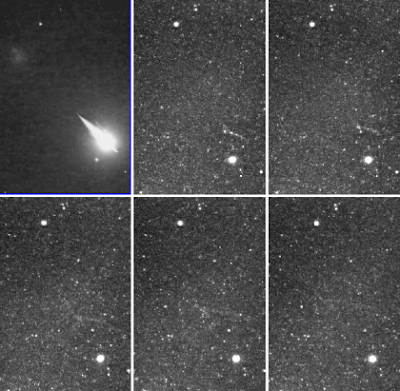
Notice that one meteor trail was 100km long!  Here's a picture of it from USL010 on 4 Dec 2021:


Just really quick there was a nice fireball going right by Sirius on the 4th.  Left a trail for >5 min afterwards.  Here are some pics:


more as time allows...

Sunday, April 4, 2021

First Speckle Data is Confusing

I took my first speckle data last night (03 Apr 2021).  I got data on Sirius (looking for Sirius B) and Rigel (also a close binary).  While collecting the data and watching the screen, I saw something strange but I pressed on and collected it all.

When I was done I immediately started looking at the data closely.  What I saw was this typical 33 millisecond 'color' (using my ZWO-ASI385MC) image:


Let me explain this image a little more....

This is a very short exposure -- 33 milliseconds -- of Sirius.  An exposure of that length effectively 'freezes' the atmosphere and we see for this instant the extent and other qualities of the distortion.  Above the atmosphere, Sirius would be on a single pixel.  Instead, we get this complicated blob.  This distortion is very dynamic and causes what astronomers call 'seeing'.  There are two different kinds of distortions.  The first effects the amplitude of the wavefront, the second effects the phase of the wavefront.  Amplitude modulation caused by atmospheric distortion is called 'scintillation', oftentimes called 'Twinkling'.  Phase modulation causes 'seeing' and the complex structure you see in this image.  As the wavefront moves through the atmosphere, differences in refractive index of the air (caused by temperature differences, humidity, other aerosols, wind speed and direction, etc.) causes the wavefront to distort and become out of phase.  This has the effect of distorting the image spacially in the very complex pattern you see.  The airy rings (partial, in this case) are caused by the telescope optics -- you can hopefully see these rings surrounding a central round blob.  That round blob is the diffraction-limited image of Sirius as if there weren't any atmosphere.  Speckle Interferometry takes advantage of this and attempts to reconstruct a high-resolution long exposure image (I have 3000 images, at 30 fps that's 100 seconds).  In this case I'm hoping to see the white dwarf Sirius B.

A very important part of speckle interferometry is to do the observations using a narrow-band filter.  I just so happen to have a Hydrogen-Beta filter that's pretty narrow band (25 nanometers, 250 Angstroms).  It's a wonderful blue and, in fact, my favorite color.  The 'color' image above doesn't do it justice.

So here's the problem I have with this image: why am I seeing 'blue' parts and 'white' parts?????

Here's another image:


I'm completely baffled by this.  The only 'color' I should see is BLUE, since that's the only wavelength I'm (supposedly) letting through with the H-Beta filter.  The white pixels (which means there's red, green, and blue light getting through!!) shouldn't be there -- or at least I don't think so! (please see update 2021.04.06 below)

Assuming that it's correct, what would cause this?

Assuming that it's NOT correct, what would make it happen?

So what to do?  I thought about putting my eyeball on it with the hope of seeing something I'm not seeing with the camera.  If I don't see it with my eyeball, then I know it's a camera feature and I can focus on that.  But if I DO see the same blue/white thing, then what????  Well, the problem isn't in the camera, then.  Before the sensor is the filter.  Then the barlow, then the diagonal, then the secondary, then the primary, then the corrector plate.

Could the filter be doing this?  Maybe.  A filter could leak light at an offset?  Some kind of optical flaw?

The barlow is super simple -- nothing there.

The rest of the optical path is fine, as far as I can tell visually.

So what is going on???

I guess if I put an eyeball on it with and without the filter, I can eliminate that.  I could also eliminate the diagonal, but I'd have to refocus.  So that's what I'll do tonight (4 Apr 2021).

I'd appreciate any thoughts anyone has....

Update: clouds tonight.  Maybe tomorrow???

Update 2021.04:06

I'm pretty sure what I'm seeing in these images are two difference speckle patterns: blue and white.  Notice how there are more blobs in the blue than in the white?  That's exactly what I'd expect using a narrow-band filter versus a wide-band filter.  A wide-band filter would also produce the white light.  What I still don't understand is the relative offset -- why is blue on the left and white on the right?  I'm still baffled about how this could happen.